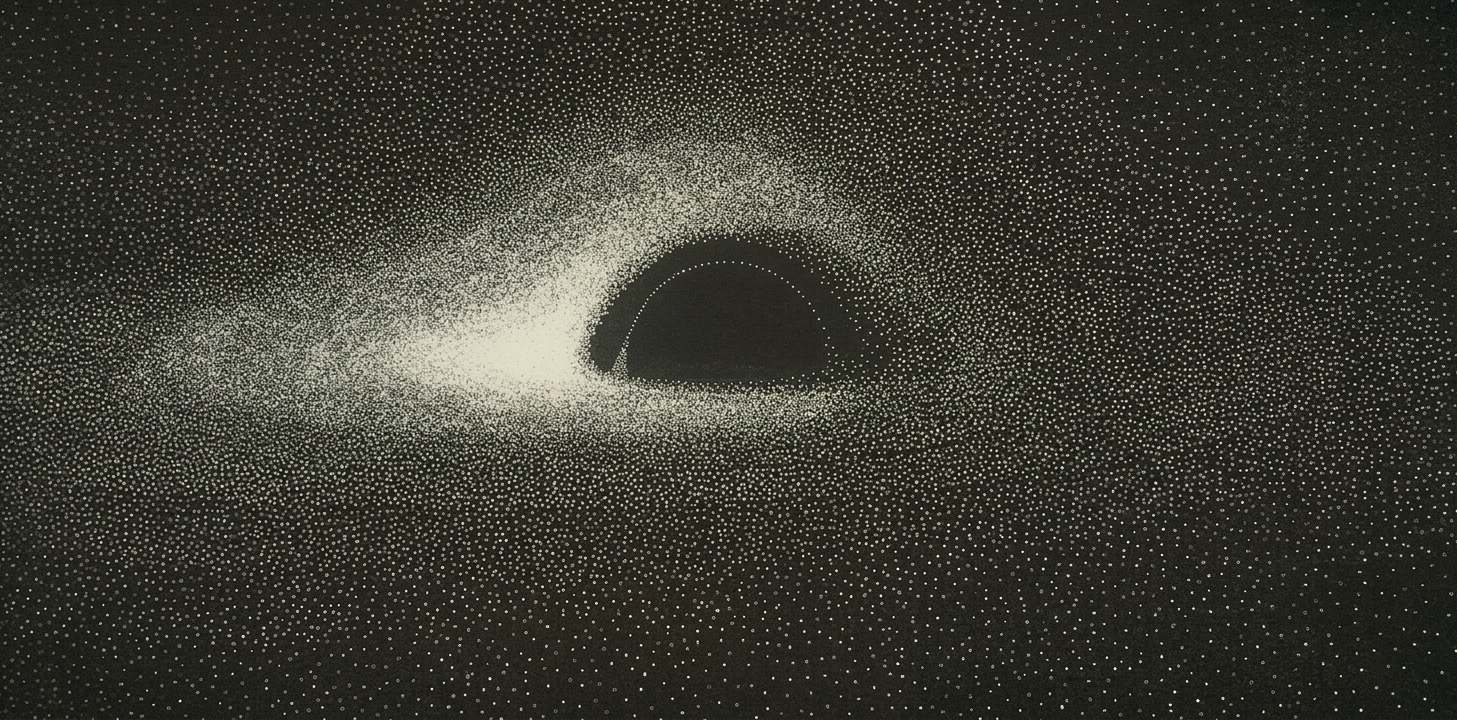
One of the fascinating topics I read about recently is how developments in physics have changed our understanding of what can be done with computers. Let’s say, for example, that a day near a black hole equals a year on Earth, and you want to run a program that takes a year to finish. Could you wait a day near the black hole instead of a year on Earth? This is the topic of this post in short, and before we begin, I will explain some basic concepts we need. There are two points I adhered to while writing:
- I will not delve into the complex theories of relativistic physics or advanced concepts in computing.
- I will restrict myself to ideas that are theoretically, and to some extent practically, possible; meaning, there is no science fiction here.
Therefore, this post is suitable for anyone, even non-experts, and the interested reader will find the terminology and references they need if they wish to learn more. You might think the idea is impossible, but you will be surprised by how possible it actually is!
Introduction
Any program executed by a computer can be divided into simple operations that occur in every unit of time. For example, adding two numbers every second, multiplying two numbers every two seconds, copying a byte every second, etc. Defining programs by the number of operations allows us to define programs that can be completed in a reasonable amount of time, and some programs are endless in the sense that the number of operations is infinite or near-infinite (see “Computability”). This is how we can define the problems a computer can answer and the problems that cannot be computed, for no other reason than the limits of time. However, these theories were established at the beginning of the twentieth century, before the theory of relativity.
The relativity of time—meaning that time advances at a different pace in different places—can be easily proven using simple ideas everyone knows. Take this example: let’s say you are on a train moving at a constant speed and you place two mirrors, one on the floor and the other on the ceiling, then shoot a beam of light from the first to the second. Calculate the time the light needs to cover this distance using your watch, while I look at you from afar outside the train with my watch. The time calculation is intuitive: $t=\frac{2d}{c}$, where d is the distance and c is the speed of light, but does the light move from my perspective as it does from yours? From your perspective, the light travels in a straight line, as the two mirrors are facing each other throughout the cycle. However, from my perspective, the ceiling mirror will move slightly while the light completes its cycle, and therefore the light’s path is a diagonal line, not a straight one! Thus, the light travels a longer distance. If we accept that the speed of light is constant (and this is not an arbitrary assumption but a consensus), you will say that the cycle takes one second, for example, whereas from my perspective it will take a second and a half, for example. Therefore, from my perspective, time is passing slower for you.
Your Perspective
External Perspective
We can even easily calculate the ratio between my time and your time if we use the Pythagorean theorem. Let’s say the distance the train travels per second from my perspective is the adjacent side, equal to $v*t_i$ where $v$ is the train’s speed, and the distance of each cycle from your perspective is the opposite side, equal to $c * t_u$, and the hypotenuse is the diagonal distance the light travels, which represents the time of each cycle from my perspective, equal to $c * t_i$. We get the following:
$$ (c * t_i)^2 + (v * t_i)^2 = (c * t_u)^2 \\ t_u = t_i * \sqrt{1 - \frac{v^2}{c^2}} \\ t_i = t_u * \frac{1}{\sqrt{1 - \frac{v^2}{c^2}}} = \gamma * t_u $$
And because the factor $\gamma$ is always greater than 1, more than a second will pass for me for every second that passes for you1. The train example was proposed by Einstein around 1917 in a different form. ( Citation: Papaliolios, 1971 Papaliolios, C. (1971). Relativity Train. Retrieved from https://sciencedemonstrations.fas.harvard.edu/presentations/relativity-train ) . Although this example is simplified, there are many experiments by NASA and others that prove this principle.
Relativistic Computers
We can now delve into the core of our topic, and I expect the idea has already begun to form in your mind before I even explain it. Let’s say we set up an environment around the computer where time differs from our location, meaning the time dilation factor gamma $\gamma$ at the computer is different. If this factor was less than 1, it would seem to us as though the computer is faster than usual, as time passes faster for it. What if gamma was zero or closer to zero? Then, even if an eternity passed for the computer, only a limited amount of time would pass for us. Can we then control this factor so that it becomes zero or closer to zero?
In the train example, the difference in the time factor was due to the train’s speed, and thus it can be increased or decreased by changing the speed of the train itself. This is the first proposal: traveling on a spacecraft traveling at or near the speed of light while the computer remains on Earth, though this proposal is fragile for obvious reasons. The other proposal is to use gravity. Gravity has the opposite effect of speed: it slows down time, for reasons we do not need to explain here. We see this idea every day even if you don’t feel it; computers on satellites run faster than Earth-based computers by about 38 microseconds due to the weaker gravity there ( Citation: Ashby, 2003 Ashby, N. (2003). Relativity in the Global Positioning System. Living Reviews in Relativity, 6(1). 1. https://doi.org/10.12942/lrr-2003-1 ) . So, by being in a highly gravitational body, gamma between us and the computer becomes less than 1, and the bodies with the strongest gravity in the universe are black holes, of course! The plan is:
- We travel in two spaceships, one for me and one for the computer, close to a massive black hole.
- My spaceship descends into the black hole gradually. The closer I get to the black hole, the slower time passes for me, all the way to what is called the “Event Horizon”. There I can wait for a limited amount of time.
- The computer runs the operations I requested during my descent and sends me the result as soon as it finishes.
- If the computer needs a period of time to send me the result, no matter how long, it will reach me in a limited amount of time, let’s say a duration of b.
In this way, the result reaches me even if the computer needed an eternity. You might say there is an obvious problem here, which is that I will die due to the black hole’s gravity, and you are right! If we assume a random black hole was chosen. But, if we choose the appropriate black hole, there is no problem, as we will see.
Rotating Black Holes
There are generally four types of black holes:
| Rotating | Non-rotating | |
|---|---|---|
| Charged | Kerr-Newman | Reissner-Nordström |
| Uncharged | Kerr | Schwarzschild |
The fourth type, Schwarzschild, is the type people usually imagine when talking about black holes. All four types are theoretically possible, though we have only found the uncharged rotating type (Kerr) so far, and the other three types are not believed to exist. The rotating type is sufficient for us anyway, as what we are trying to achieve is a way to fix my position at a constant distance from the event horizon so that the computer’s messages reach me and gravity doesn’t destroy me; meaning, I need something to counteract gravity. Any rotation produces a force we call centrifugal force that expels matter away from the axis of rotation, which in the case of a black hole is its center point or the Singularity. The centrifugal force intensifies as we approach the center, until it reaches a point where it exceeds the force of gravity. Thus, two regions are created inside the black hole: (1) a region where the force of gravity overcomes light, meaning matter can only fall towards the center, and (2) a region where the centrifugal force prevails, so matter can move freely. We call the event horizon for the first region the outer event horizon, and for the second region the inner event horizon2. The ratio between the two regions is governed by the black hole's rotation speed. The faster it rotates, the greater the centrifugal force, and consequently, the larger the inner region where matter moves outward rather than inward. You might imagine, then, that if the rotation speed reaches a certain limit, the centrifugal force would overcome gravity throughout the entire black hole, and this is true! In that case, there is no outer event horizon, and matter, especially light, can be emitted from the black hole. This is what is called a Naked Singularity. However, it is not believed to exist due to various considerations like the cosmic censorship hypothesis. If it did exist, it would change our understanding of many things, and if you could create one in a microwave, you could send emails to the past... . In the stationary type of black holes, only the first region exists.
So we go to a supermassive rotating black hole, the kind found in the center of galaxies ( Citation: Chang & Kiang, 2025 Chang, C. & Kiang, J. (2025). Simulations of images of accretion discs around Kerr black holes relevant to M87*. Monthly Notices of the Royal Astronomical Society, 544(2). 2599–2613. https://doi.org/10.1093/mnras/staf1803 ; Citation: Ferrarese & Merritt, 2002 Ferrarese, L. & Merritt, D. (2002). Supermassive Black Holes. Retrieved from [https://arxiv.org/abs/astro-ph/0206222]() ) . There I can descend inside the outer event horizon and orbit the black hole without falling straight down, thanks to the black hole’s rotation as we mentioned. I can also control the speed of my descent and my trajectory to give the computer enough time b to send the results, then I land in the inner event horizon.
A spatial diagram of a rotating black hole. $\gamma_p$ is my trajectory within it, e is the moment of my descent into the outer event horizon, while b is the moment of my descent into the inner event horizon, and the singularity becomes a ring due to the centrifugal force. Adapted from ( Citation: Németi & Dávid, 2006 Németi, I. & Dávid, G. (2006). Relativistic computers and the Turing barrier. Applied Mathematics and Computation, 178(1). 118–142. https://doi.org/10.1016/j.amc.2005.09.075 ) .
Some Objections
The High Gravitational Forces at the Event Horizon Will Destroy You
The tidal force (also known as the “spaghettification effect”) of a supermassive black hole is weak due to its vast size. I can cross the outer or inner event horizon of a black hole with a mass $10^7$ times the mass of the Sun without feeling a significant or noticeable change in the gravitational force ( Citation: Ori, 1992 Ori, A. (1992). Structure of the singularity inside a realistic rotating black hole. Physical Review Letters, 68(14). 2117–2120. https://doi.org/10.1103/PhysRevLett.68.2117 ) . These and heavier ones exist, as we mentioned.
Even if You Survive, You Won’t Escape the Black Hole
This is true, as matter cannot escape the outer event horizon. Think of it as a trade-off: would you accept spending the rest of your life inside a black hole in exchange for getting an answer to a scientific question? To a problem you spent years thinking about? Some might accept that. It might be a problem they devoted their life to without an answer. As we said, theoretically, a human can stay inside a black hole forever without danger; in fact, you could take your family and spend the rest of your life aboard the spaceship, enjoying the knowledge provided to you by the computer from outside the black hole.
No Computer Can Run Forever
Perhaps, and perhaps we will find a way to create a self-healing machine and an intelligent system to take care of it. Self-healing machines are an active area of research, and artificial intelligence is developing rapidly as we can see, so I don’t find it that far fetched.
Conclusion
This research field is called Hypercomputers, and there are other proposals to build them that have nothing to do with black holes, though they are less realistic than the aforementioned model. What prompted me to write this post is this paper I found by chance: Relativistic Computers and the Turing Barrier, which is the primary reference for this post. The topic fascinated me not because I will board a rocket and head to a black hole carrying a laptop, nor because I will get these hypercomputers anytime soon, but rather for the sake of learning about physics and computers. There are many things I didn’t touch upon, such as other theoretical objections like the Cosmic Censorship hypothesis, or the theoretical details of relativity and black hole physics.
I hope the post piqued your curiosity about the subject like it did mine.
References
- Chang & Kiang (2025)
- Chang, C. & Kiang, J. (2025). Simulations of images of accretion discs around Kerr black holes relevant to M87*. Monthly Notices of the Royal Astronomical Society, 544(2). 2599–2613. https://doi.org/10.1093/mnras/staf1803
- Papaliolios (1971)
- Papaliolios, C. (1971). Relativity Train. Retrieved from https://sciencedemonstrations.fas.harvard.edu/presentations/relativity-train
- Ashby (2003)
- Ashby, N. (2003). Relativity in the Global Positioning System. Living Reviews in Relativity, 6(1). 1. https://doi.org/10.12942/lrr-2003-1
- Németi & Dávid (2006)
- Németi, I. & Dávid, G. (2006). Relativistic computers and the Turing barrier. Applied Mathematics and Computation, 178(1). 118–142. https://doi.org/10.1016/j.amc.2005.09.075
- Ori (1992)
- Ori, A. (1992). Structure of the singularity inside a realistic rotating black hole. Physical Review Letters, 68(14). 2117–2120. https://doi.org/10.1103/PhysRevLett.68.2117
- Ferrarese & Merritt (2002)
- Ferrarese, L. & Merritt, D. (2002). Supermassive Black Holes. Retrieved from [https://arxiv.org/abs/astro-ph/0206222]()